Potato
Kabwe, Zambia
Crop | Potato
Trial Duration | 5 months
Co-operators | Select Seeds
55%
Saving on water
About the Trial
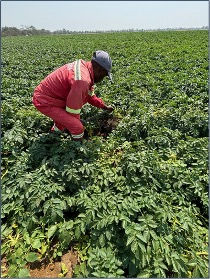
The trial evaluated Aqualatus on potatoes grown under pivot irrigation, applied at 2.0L/Ha at planting, followed by three monthly applications of 1.0L/Ha (each watered in with 5mm/5L of water).
Soil type, terrain, and irrigation challenges: High-quality sandy loam over sand, with a high level of humus. The topography was flat, with irrigation supported by a reservoir. However, water costs on the farm are high, as water is double-pumped — first from borehole to reservoir, then from reservoir to pivot.
Aim of the Trials
To evaluate whether Aqualatus could maintain soil moisture and reduce the irrigation requirement of potatoes under pivot, and to assess any impact on yield.
Moisture at Depth
The irrigation team carried out weekly soil cores to record moisture depth on a notation scale. The Engage team visited on 16 September and observed uniform moisture down to 1m.


Irrigation Level
Irrigation dropped from 25mm every 3 days (on the neighbouring pivot) to 15mm every 4 days within 4 weeks of the first application.
Extrapolated over a month, this represents a reduction from 2,500m³ to 1,125m³ — a saving of 1,375m³ per hectare per month. Across the whole pivot, this equates to 36,320m³ saved over the two-month trial period.
Pivot Irrigation per m³/ha per month

Results
Yield data per hectare:

-
Aqualatus maintained soil moisture under the potatoes at 65–70%, reducing irrigation from 25mm every 3 days to 15mm every 4 days — a 55% reduction in irrigation.
-
Crop growth was more uniform, with moisture levels remaining even down to 1m.
Conclusion and ROI
The data show that Aqualatus was a positive addition to the 2024 season trial, returning a higher price per tonne for the crop. While the good soil quality on this pivot likely contributed to the strong results, the water savings were substantial and yield increased by 6%.
ROI:
The cost of water to the grower — accounting for borehole extraction, pump running costs, pivot irrigation energy (electricity or diesel), maintenance, and labour — is estimated at $1,000–$2,500 per hectare annually, depending on pivot size, energy source, and seasonal maintenance needs. Aqualatus enabled a reduction in irrigation, saving a proportion of this cost.
Water extraction costs, including electricity, run at approximately 3 Kwacha per m³ ($0.09). Since water is pumped twice on this farm, the effective cost doubles to 6 Kwacha, with higher costs during periods when diesel is used in place of electricity.
ROI | Control plot | Aqualatus Plot | Difference |
|---|---|---|---|
Water use per hectare | 10000m3 | 5875m3 | Saving of 4125m3 |
Cost of water per hectare | £1,800 | $1057 | Saving of $743 per ha |
Cost per Ha for running the pivot | $1000-2500 | $450-1125 | Saving of $550-1375 per ha |
Yield per hectare at $680.00 per tonne | 68.9Ton ($46,852) | 73.1Ton ($49,708) | An increase of 4.2 Tonnes ($2856) |
Cost of Aqualatus (8 litres per ha) | $0.00 | $200.00 | Cost of application $200.00 per hectare |
Total ROI at current water cost | 20:1 – 24:1 |
Yield increased by an average of 4.2 tonnes per hectare, raising overall pivot yield by 67.2 tonnes.